
Asia-Pacific is now home to more of the world’s largest exhibition venues than any other region, according to the 2026 edition of the World Map of Exhibition Venues, released by UFI, The Global Association of the Exhibition Industry and produced by jwc. The new edition counts 41 venues with 100,000sqm or more of indoor exhibition space in Asia-Pacific, compared with 38 in Europe. A year ago, the two regions shared the lead.
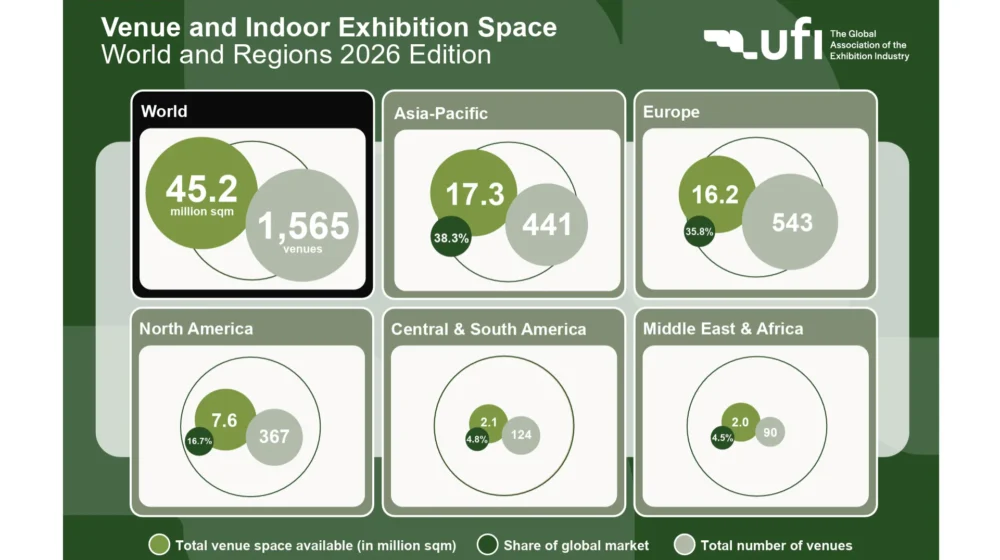
Worldwide, the survey identified 1,565 venues offering at least 5,000sqm of gross indoor exhibition space, with a combined 45.2 million sqm as of 31 December 2025. This is 35 venues and around 0.9 million sqm more than in the previous edition.
Chris Skeith OBE, UFI CEO, said: “Exhibition venues are long-term investments in economic infrastructure. This year’s World Map shows venues tracking industrial growth worldwide, with global capacity at 45.2 million sqm and Asia-Pacific ahead of Europe in mega venues for the first time. Central and South America, and the Middle East and Africa are also steadily building their share. For organisers, this means real room to expand into markets positioned for growth, with capacity built for the future.”
Asia-Pacific now holds 38.3% of global capacity (17.3 million sqm). North America follows with 16.7%. Beyond the three established regions, Central and South America (4.8%) and the Middle East and Africa (4.5%) together now account for 9.3% of global space, up from 8.4% a year earlier.
Venue scale also differs markedly between regions. Asia-Pacific venues average 39,238sqm in size, compared with 29,802sqm in Europe and 17,327sqm in Central & South America, which remains the only region without a venue of 100,000sqm or more.
Globally, however, the market is still built on smaller facilities: 62% of venues offer less than 20,000sqm, 33% between 20,000 and 99,999sqm, and 5% (84 venues) 100,000sqm or more. The Canton Fair Complex in Guangzhou remains the world’s largest venue, with 504,000sqm.
At country level, China accounts for 30.7% of global capacity, ahead of the United States (13.9%) and Germany (7%). Together with Italy and France, these top five markets hold almost 63% of the world’s indoor exhibition space. Seven countries offer more than 1 million sqm each.
Jochen Witt, president and CEO of jwc GmbH, added: “The headline numbers are about size, but the more important story is fit. Market requirements are rapidly changing, and venue sizes and qualities need to adapt. Chasing the largest footprint is no longer suitable; successful destinations need to match capacity and quality to meet market requirements. Most of the world’s venues still offer less than 20,000sqm, which is sufficient for many markets. For cities and governments considering new venue capacities, this data provides the benchmarks to get the sizing decision right. Venue quality is another topic but needs the same extent of focus.”
The report includes detailed profiles of all 22 countries/regions with more than 300,000sqm of indoor exhibition space.
The full World Map of Exhibition Venues report, including all regional and country profiles, is available, free of charge, on the UFI website at www.ufi.org/knowledge-hub. It is also available at www.jwc.eu.com.