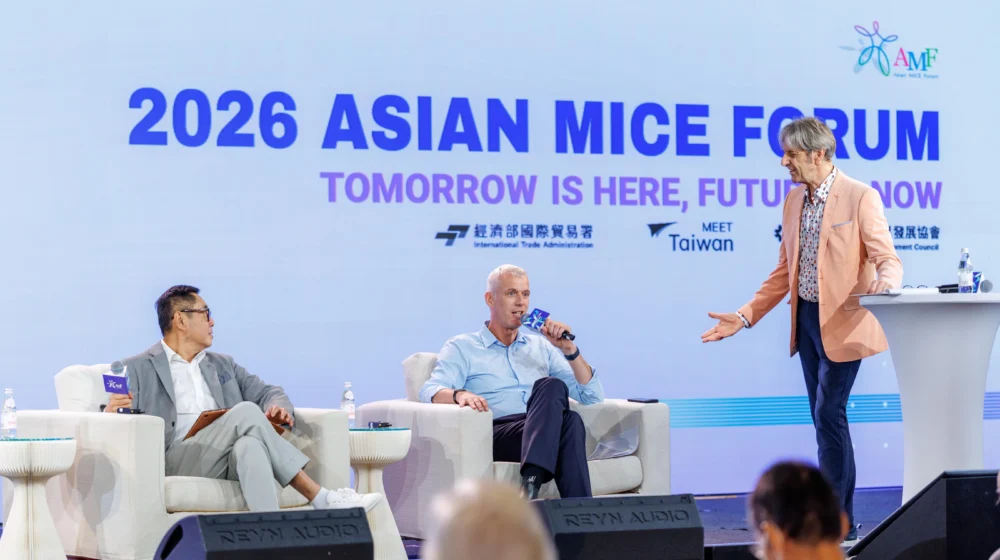
How business events create experiences that people remember, connections that last, and impact that extends beyond the event itself, were some of the questions taking centre stage at the 2026 Asian MICE Forum (AMF), held on 1 October in Taipei under the theme ‘Tomorrow is Here, Future is Now’.
Organised by the International Trade Administration, Ministry of Economic Affairs (TITA), and implemented by the Taiwan External Trade Development Council (TAITRA), the forum brought together international MICE professionals and cross-sector experts to explore changing expectations and redefine the value of gathering in an increasingly connected world.
Now in its 21st edition, AMF has welcomed more than 8,000 MICE professionals from around the world since its establishment in 2006.
Building on last year’s 20th anniversary and the launch of ‘AMF 2.0’, the forum continues to evolve as an international platform for MICE innovation.
The forum opened with a keynote by renowned architect Ole Scheeren who explored how space and design can shape human interaction and create opportunities for connection.
From content to impact
The forum then examined a key challenge: when information is everywhere, what makes an event truly valuable?
The panel ‘Too Much Content, Too Little Impact’ explored how events can move beyond information delivery to create meaningful engagement, with discussions on changing participant expectations, experience design, and technology. More importantly, the discussion underscored that human connection and interaction remain irreplaceable.
The conversation continued with ‘Designing from Feeling to Remembering’, featuring perspectives from C2 Montréal and South by Southwest (SXSW). At the heart of these approaches is the creation of experiences that evoke emotion through immersive co-creation and human connection, fostering a sense of belonging and shifting the focus from simply delivering content to creating memorable experiences.
This year, AMF also incorporated practical carbon-reduction measures estimated to have reduced emissions by approximately 38%.