The events market has changed. What was once a relatively predictable cycle of space bookings, sponsorship packages and year-on-year renewals has become a more complex, scrutinised and competitive landscape. Buyers today operate in an environment of greater choice, tighter budgets and heightened accountability. For event sales teams, that shift is not merely operational – it is fundamental.
According to Raoul Monks, CEO of UK sales transformation company Flume, the challenge facing event businesses is not simply about getting better at selling. It is about understanding a buyer who now has more information, more options and more pressure to justify every purchasing decision.
Digital platforms, hybrid formats, content partnerships and alternative marketing channels compete for the same budgets that once gushed into exhibitions and conferences. At the same time, internal scrutiny has intensified. Procurement teams, finance stakeholders and multiple decision-makers routinely examine every proposal. ROI is no longer a post-event talking point; it is a prerequisite for sign-off. The result is longer sales cycles, more stalled deals and a higher proportion of opportunities that simply disappear into the sands.
In this environment, the highest-performing event sales professionals stand apart. They do not rely solely on product knowledge, rate cards or relationship history. They focus on the person behind the buying decision and understand that the individual tasked with recommending or approving an exhibition investment is navigating personal as well as commercial risk. Will this decision deliver the leads or market access their organisation needs? Will it justify the spend to their board? Will it make them look good – or expose them?
For Raoul Monks, the common thread running through those issues is relatively simple: making it easier for buyers to have confidence in the decisions they are making. His approach to sales has been shaped by more than a decade working in sales and commercial leadership before moving into consulting and training. Flume, which he founded in 2010, was built around a frustration with traditional sales training and the idea that giving people more information doesn’t necessarily make them better at their jobs.
High performers recognise that the real barrier is rarely price or product features alone, says Raoul Monks. It is confidence. When a buyer lacks confidence in the outcome, the process or their ability to defend the decision internally, the default response is delay or decline, he believes. Conversely, when a salesperson systematically builds that confidence – by clarifying objectives, quantifying value, de-risking the commitment and equipping the buyer with a watertight internal case – momentum returns.
For Raoul Monks, the idea that “everyone comes in, does a training day with a flip chart or maybe a digital whiteboard, and they say fancy stuff and people take one or two little things away from it” is clearly far from good enough. “Because,” he says, “that kind of approach did not necessarily demonstrate that anything had changed once the training was over.” The answer, he says, is to focus on changing behaviour and measuring the impact rather than simply delivering another day of training.
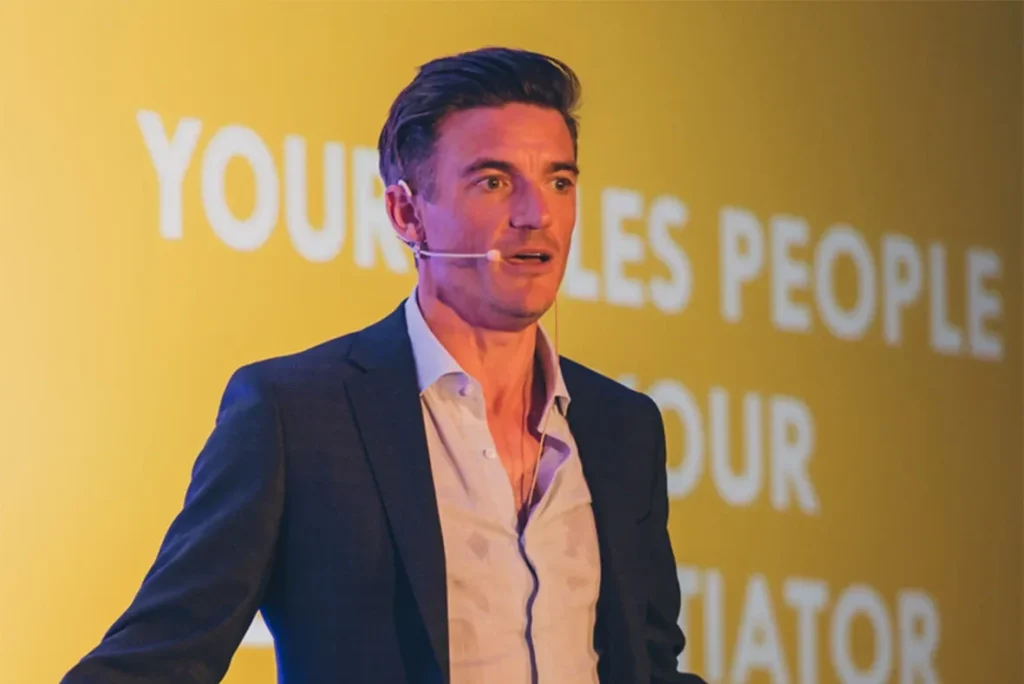
That thinking remains central to Flume’s approach, with the company describing its work as “sales team transformation rather than simply sales training”. It’s a methodology built around understanding what high-performing salespeople do differently, codifying those behaviours and embedding them across a wider team.
This has clear implications for event sales organisations. Traditional approaches that emphasise volume of activity, standard pitches or transactional closing techniques are increasingly insufficient. Teams need to shift from selling what they have to diagnosing what the buyer actually needs, and then co-creating solutions that address those needs while reducing perceived risk. That requires a deeper understanding of the buyer’s world and the pressures they work under, as well as their metrics of success.
The buying environment has changed and the events industry is competing for marketing budgets in a world where buyers can increasingly measure and compare different channels. Digital marketing, search, social media and other forms of marketing can all provide data around performance, while events have to fight hard to demonstrate their own contribution to any wider marketing strategy.
As Raoul Monks puts it, the question for a buyer is increasingly: “What impact will this have, and how can I prove that it worked?”
AI is only as good as the sales process behind it
The challenge for sales organisations is how to make those high-performing behaviours consistent across every salesperson and every deal. Raoul Monks believes AI has the potential to help close that gap.
Many of the emerging sales tools analyse conversations, assess salesperson activity and identify patterns in performance. But Raoul Monks argues that analysing what a salesperson has done is not the same as helping them improve the outcome of a live deal. Technology cannot replace the underlying methodology.
His analogy is that buying an AI tool without having the right sales methodology in place is like buying a computer without software.
The first question, therefore, should not be what AI tool a sales team can buy. It should be what needs to change to help buyers make decisions with greater confidence, and how AI can help salespeople achieve that consistently.
Flume is developing an AI Deal Coach, THEA, that sits inside Salesforce and is designed to operate within the salesperson’s workflow. Raoul Monks describes it as effectively a coach on the salesperson’s shoulder, using Flume’s Buyer Confidence Engine™ to assess what is happening in each live deal from the buyer’s perspective, identify where confidence may be lacking and recommend the next action to move the deal forward.
The intention is to take the proven sales methodology that Flume has developed through its work with high-performing salespeople and embed it into the day-to-day sales process, helping every salesperson build buyer confidence while there is still time to influence the outcome.
Buyer confidence has therefore become the key lever for improving sales performance. Organisations that equip their teams to diagnose gaps in confidence, build it deliberately throughout the sales process and measure progress against it are seeing measurable gains in win rates, deal size and forecast accuracy. Those that continue to treat confidence as a soft skill rather than a commercial imperative risk watching pipeline quality erode.
While it remains true that the events industry has always been relationship-driven, what has changed is the depth of understanding and the quality of commercial conversation required to turn relationships into predictable revenue. In a market defined by choice and scrutiny, the sales teams that thrive will be those that make it easier, and safer, for buyers to say yes.
EN Sales Leaders Summit 2027
You can learn much more about Flume at the EN Sales Leaders Summit 2027. Flume is headline partner for the event on 14 January in London.
Over the past two years, the summit has brought together 75+ sales leaders from across the exhibition organising community, and it’s set to grow again in 2027. The 2026 edition featured speakers from some of the industry’s biggest organisers, including Adam Cartledge of RX, James Samuel of Clarion Events, Harry Norman of CloserStill Media, Jennifer Burley of Easyfairs, Melanie Gividen of Terrapinn, Jonathan Kinchin of Nineteen Group and Dan Dixon of William Reed.
This year’s programme will explore how leading teams win transformational partnerships, which sales technology will actually improve performance, and why event deals are really won and lost.