
Women make up around 70% of the global events workforce but their stories, leadership, and influence are often underrepresented. The 70% is a weekly series celebrating the women shaping the events industry. From rising stars to seasoned leaders, each profile shines a light on the career journeys, challenges, and perspectives of women working across all corners of the sector.
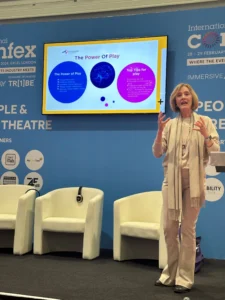
In this edition, we speak to Janthea Brigden, CEO and event childcare consultant at Nipperbout Ltd.
How long have you worked in events?
Since May 1992 – so that makes it 33 years. I started in events completely by accident, stepping in to run a crèche at an event for 60 children with just two weeks’ notice. I was an actress who’d pivoted to running childcare for fellow actors, and then at shopping centres and I said, “Alright, I’ll do that then.” It was the biggest crèche I’d ever run at the time, and I’ve never looked back.
How do you balance professional growth with personal commitments, and do you think the industry is evolving in terms of work-life balance?
I’m not sure I do balance it, to be honest. Work is constant for me – partly because I care so much. If I didn’t care, I’d probably have a better work-life balance. But when you’re dealing with children and compliance – Ofsted, safeguarding, legal requirements etc – there’s no such thing as switching off. It’s a passion, and like most passions, it leaks into every part of your life. I know a lot of people in events talk about balance, but for me, it’s about doing it properly, and that takes time and dedication.
How do you see the events industry evolving in terms of diversity, equity, and inclusion?
It’s changed massively since I started. Back in the day, events had prayer rooms and a crèche if you were very lucky. Now we have well-being spaces, sensory rooms for neurodiverse delegates, yoga, massage, even therapy dogs. It’s becoming much more thoughtful and inclusive – because it has to be. Delegates expect it now. That said, not everyone fully understands what inclusion looks like. We still get venues asking if we can just bring a few beanbags and jigsaws because they have no idea of the scale of what we do. But the demand for high quality, professional childcare at events is growing, and that’s encouraging because parents should expect the best – a few jigsaws in a room really doesn’t cut it!
My hope is that more venues will start working with us to keep equipment on-site and properly invest in childcare – for delegates and for event teams. Unison does this brilliantly by providing childcare for their team the day before the conference starts. That’s the kind of thinking we need more of.
What advice would you give to young women looking to enter and succeed in the events industry? Have a baby. I’m only half joking because there is neuroscience behind it! After having a child, your brain literally rewires itself to survive chaos – multitasking, decision-making, risk assessment – everything you need for event management. Mothers are some of the best organisers I know.
More broadly, I’d say don’t be afraid of stepping into the chaos. You’ll find your strengths in it. Women often doubt themselves or feel they have to prove they can do 100% of a job before applying. Men don’t – they go for it anyway. So be bold. Learn on the job. Back yourself. And if things go wrong, that’s okay – just learn from it and put processes in place so it doesn’t happen again.
How do you handle setbacks and failures?
I hate them. I’m a perfectionist, so I go over every detail to figure out what went wrong and how to stop it happening again. If something happens once, it’s a mistake. Twice, it’s careless. Three times? Unacceptable. That’s my mindset.
But events are inherently unpredictable. I’ve come to realise a lot of us in this industry thrive on crisis. There’s even a word for it – ‘Lachesis’ which means the creation of drama. People with a Lachesis profile may unconsciously generate chaos or conflict to feel alive or in control, but it also makes us great at deflecting those curved balls! For some, it’s rooted in childhood trauma, and events give us a way to channel that into purpose. I’ve met loads of former performers and theatre people who’ve ended up in events – it’s the same adrenaline, the same high-pressure performance, just in a different form.
What changes do you think are still needed to create more opportunities for women in leadership?
More accessible, affordable childcare is crucial and not just for delegates, but for staff. We need to support women to take on big roles and be present for their families. We also need a mindset shift. Employers should see mothers – and parents in general – as assets. The skills you gain from parenting translate directly into events: problem-solving, planning, adapting under pressure. And of course, we need to get more women into the top jobs. So many of my clients are women, but when you look at the C-suite level, it’s still dominated by men. That gap hasn’t closed yet.
Recognition, representation, and flexibility – those are the keys to progress.