

DSEI is the largest trade show in the United Kingdom. Recent Clarion numbers quote revenues of £31 million. But a weird collection of strange events almost destroyed DSEI in its very early years.
To begin with, the very first DSEI at Excel opened on 11 September 2001. More on that unfortunate timing later.
The event had been conceived by Bob Munton, CEO of Spearhead Exhibitions. I was the Chairman of what began as a very small company with around 25 employees. DSEI was to be the biggest tri-service defence show in the world, and that is what it has become. Land defence was relatively easy. Sea defence was represented by up to 11 warships which sailed up the Thames and moored beside Excel. And air defence by 2001 was about the avionics rather than metal bashing and this was not difficult to exhibit – much of the electronics/avionics base applied equally to sea, air and, to a considerable extent, land.
“DSEI was to be the biggest tri-service defence show in the world, and that is what it has become”

But as soon as the first show was announced another problem reared its head. This was protesters, marshalled under an “anti-War” banner and a favourite of The Guardian. The Ministry of Defence was a partner, and they worked closely with MI5 and Scotland Yard on possible protests. The Met knew from very early days how the protests were organised and whom they judged to be the main players. There was significant overlap with Animal Rights protest groups. The same names kept cropping up.
Spearhead had agreed to build a “ring of steel” around Excel, which meant that no other shows could run at the same time, and that any visitors had to be examined well outside the halls. But this did not stop protesters. Tactics included strapping themselves to the top of DLR trains, thus disrupting access to Excel as well as The City and, on one occasion, getting inside the venue and pouring concrete down the toilets.
The terrifying threat from talcum powder
Spearhead was based in RX for the 2003 event and the protests continued. On one occasion the RX offices had to be cleared when a parcel obviously containing white powder was delivered to the post room. It turned out to be talcum powder but the post room staff refused to handle any post for Spearhead after that.
Generally the protests were held on the perimeter of the venue and on the access roads. But for the Metropolitan Police this was no help. Under public order rules, they had to police the protesters and arrest anyone who got out of hand.
“The Guardian appeared to set aside four pages a day every time the show ran”
The protests and DSEI were always very heavily publicised – The Guardian appeared to set aside four pages a day every time the show ran. And because the Met could not predict the size of the protests, they needed to have a large number of police on hand.
And so the matter of cost reared its head.
The Met calculated that policing the event was costing them £4 million every time it ran (I have no idea how big that bill is now – and the protests are far smaller nowadays). We were never able to verify that £4 million number. So, every time the event came around, Bob Munton and I hosted the Assistant Commissioner of the Met and several other high-powered officers. They came to ask us to pay the £4 million, or they would have to consider withdrawing their permission for the event to continue.
This was no empty threat. The show was not so big at that time, and a £4 million bill would have finished us. DSEI would have been strangled at birth.

The threat to cancel the event was real
We argued that the protesters were nothing to do with us, that we did not invite them to the event, that they were protesting on what was public land, and we could not be held responsible. The police quoted other crowd control situations, particularly football matches.
As it happened, I had been Chairman of a Premier League Football Club (Nottingham Forest) and was still on the board – and had had many discussions with the Nottinghamshire police about crowds at our games. The difference, of course, is that the club had de facto invited the crowds to the football match, and should thus share some of any necessary cost of shepherding them. We had never invited protesters to DSEI, in fact we discouraged them in as much as we could.
The discussions went on and on. In the end, though I cannot prove it, the Ministry of Defence was critical. We had set DSEI up in such a way that we hosted delegations from the military in many countries – as many as 77 in one year. The Ministry of Defence handled these invitations and saw them as a major shop window for British industry. No doubt there were discussions at government levels.
So that threat went away – though it has reared its head on occasions since.
By 2.30pm on the very first day the hall was empty
But that was only one of the many strange elements which surrounded DSEI. Bob Munton had spent many years planning it (he received an OBE for his efforts) and then, on the very first day of the very first show – the Twin Towers fell. The first pictures came through to the hall at 2pm in London (9am in NY). By 3pm the hall was largely empty. All of the military brass – and there was a hell of a lot – had rushed back to their embassies.
For the next two days the hall was, to say the least, subdued. You can never tell how a massive external event can affect an exhibition, and we were not running again until 2003. But, in retrospect, it did seem that the show survived it well – and grew and grew to become Britain’s biggest. But it is possible that running the very first show on 11 September could have been collateral damage.
“The destroyer was put on full missile alert, ready to shoot down any recognisable threat over London if necessary”
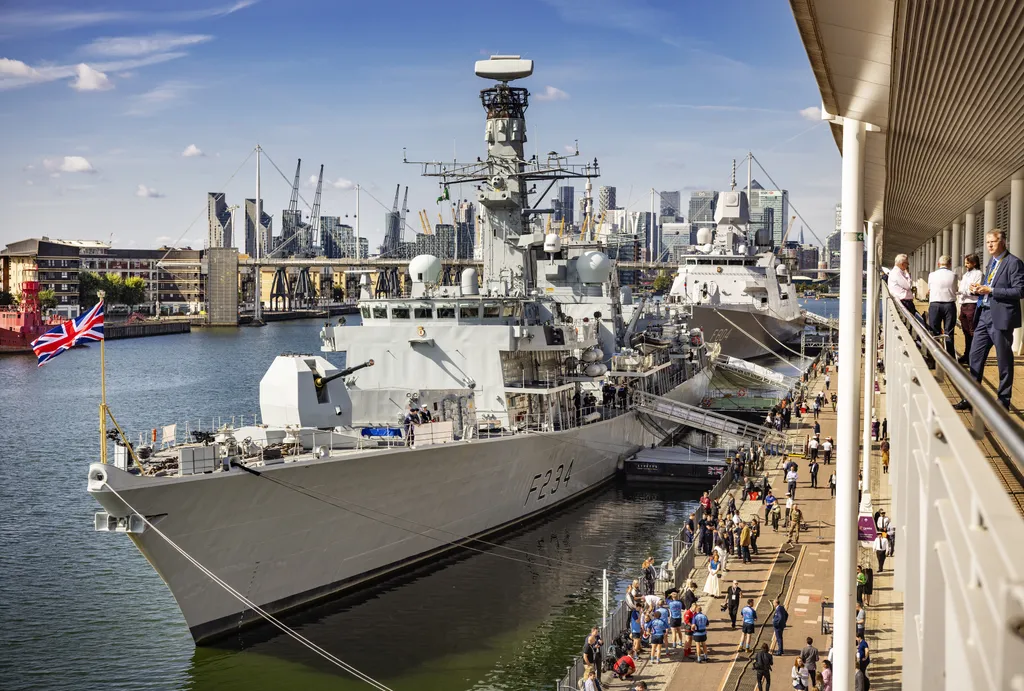
We discovered later that DSEI had become one centre of London’s defence. One of the ships moored alongside Excel was a British destroyer equipped with 22 missiles. The Ministry of Defence worried that they had to deal with a similar threat to the Twin Towers, and they thought Canary Wharf, right next to Excel, was the most likely target. So the destroyer, which had state-of-the-art radar tracking systems which could pick up abnormal incoming danger 100 miles away, was put on full missile alert to, if necessary, shoot down any recognisable threat over London.
“During the whole time that we owned Spearhead, we never ran a single show”
This wasn’t the only oddity. Spearhead had three major shows – DSEI, Offshore Europe in Aberdeen, and Helitech. But there was a problem – all three were biennial and ran in the September of the odd years. Thus, once every 24 months, chaos. But we had bought the company at the end of 1999. We owned it for 21 months before selling to Reed. And during the whole time that we owned Spearhead, because of their biennial nature, we never, ever ran a single show.
That, I am sure, was unique.