

EN guest editor Phil Soar explores the “enduring mystery” of trade show square metre pricing.
Those who read my jottings will know that, apart from the Brexit lunacy, nothing agitates me more than the way we price our core product – trade show square metres.
There are variations with “packages” and the like, but sqm represent some 80%-90% of our revenues here in the UK. I have strong views on the pricing of sponsorship and delegates (20% for Early Birds – really!), but will leave those for another day.
The mystery for me started with the very first meeting I had after becoming the CEO of Blenheim. Our biggest show was Networks at the NEC -15,000 square metres net and so popular that exhibitors had to enter a ballot to fight for space. The team was charging 183 per square metre with the normal variations for shell etc.
“Why 183?” I asked. “Well, we took last year’s price and added inflation.” So I asked the obvious: “If you charged 189 or 199 would you sell one square metre less?” “No of course not. Wouldn’t make any difference at all.””OK, so why don’t you?”
At 199 they would have added 240,000 to their profit with no costs. It would have increased their personal sales commissions by 24,000.
The result of the conversation – confusion and incomprehension (on both sides).
“Last year plus inflation: the CEO said 5%: always add 10″
I recently called 15 trade shows, chosen at random, and asked what they charged. The variation was from 300 to 790 per square metre. Only 3 were pricing at xx9 (which confirms my own despondent state). I did ask a very simple question – why were their prices where they were? Most assumed I was asking for a discount and some offered one.
But the answers won’t surprise you:
“Last year plus inflation.”
“The CEO told us to increase by 5%.”
“The CEO said no more than 2% than last year.”
“We always increase it by 10 each year.”
In only one case did the event had a real competitor which they took account of (fair enough) – but very few established trade shows have direct competition in season or location, and European comparisons are just spurious (we are a provincial market).
I also asked the obvious:
“Do you ever debate what your market will bear?”
“And why do you think 370 or 420 is the right price? – Do you in fact think there is a “right” price?”
To be fair, there were worries about whether raising prices might cause them to lose exhibitors. But when I asked whether this had ever been tested (there are plenty of ways of doing this) not a single person said that they had ever tried.
No meaningful answers. And as ever when trying to understand the largely inexplicable, I had to consider how we ever came to arrive where we are.
A brief history of trade shows and their pricing
From the early days (circa 1900 – Montgomery’s Construction event dated from 1895) through the 1960s the great majority of larger shows were organized by the relevant trade association and held at Olympia, Earl’s Court or Castle Bromwich. Typical events were the British Dental Show, the Bakers’ Show, the Motor Show, the Radio Show, the Giftware Show. In an age before television advertising (introduced 1955), radio advertising (1968 if we exclude the pirates), and glossy magazines (late 1960s) trade shows were an important, rare and demonstrable way of reaching a B2B audience.
Pricing was essentially a reflection of costs. The Associations were formed by their own exhibitors so they needed only to make a small surplus on the events. This then defined the price of exhibiting – enough just to meet the costs. (As an aside, this changed in later years when the larger events became a source of important income for some of the association members). And there are still some shows today where there are fights between exhibitors and their association about how much they are charged – one consequence is that some association events cannot invest in the extras and add-ons that privately owned events regard as part of the visitor experience.
Trade shows as three dimensional magazines
From around 1970, the publishers of B2B trade magazines (Reed, Morgan Grampian, EMAP and others) recognized that they could also run shows in sectors where they had a presence – their advertisers could be their exhibitors and their readers could be their visitors (this is the period when trade shows were usually called “three-dimensional magazines”). And so a different sort of trade show grew up – where the support of the main trade magazine (Draper’s Record in clothing, Cabinet Maker in furniture etc etc) became core to new successful events, and often a source of conflict with the trade association. For many years there was an interesting debate about a 6 metre stand costing the same as a page in the trade magazine – and the ROI on both.
For these publishers, the achievable margins on trade shows looked very attractive, particularly as they were often promoting them cheaply in their own magazines. It was a real win-win.
The Financial Times starts writing about Blenheim
And then came the great explosion of the late 1980s when a small group of entrepreneurs at the three behemoths – Reed, EMAP and Blenheim – discovered that trade shows were hidden diamonds. They very quickly generated margins of 25% plus. This was not a visible issue for Reed and EMAP, where exhibition profits were hidden in the larger group. But at Blenheim we were publicly quoted and a pure exhibition play – one which received disproportionate attention from the Financial Press because of our uniqueness in the media world. The Lex column in the FT would cover Blenheim with some bemusement, but often comment on the remarkably high margins.
Of all 2,500 publicly-quoted companies in the UK in 1993, Blenheim had the 13th highest profit margin – and the other 12 were either oil companies or brewers. Blenheim was also in the top 10 of the 2,500 companies for revenue and profit per employee. Those two facts show how unusual trade show companies were at the time. No wonder the FT paid attention to this odd arrival which had only really existed for 5 years. One problem we thus had at Blenheim was that exhibitors read the FT – and it was probably the first time that they had ever thought about the profits the organisers made, or indeed who the organisers were. Most still thought that the venues owned the events.
I recount this because I rather suspect it had a subconscious effect within the industry. Margins of around 25% plus were excellent – and with the cash coming in up front. But there was almost a sense of “That’s good – let’s not rock the boat,” and the large organisers began to regard their margin targets as being around that level and looked to sustain them without analysing why and how they had got there (the core reasons, of course, being the slot system and the subscription effect of rebooks). It was almost as if they were afraid of hitting even higher profits.
(Some businesses did exceed these levels – both Spearhead and Furniture and Gift Fairs operated at 40% and Emerald ran at 44% for many years in the US and was consistently the most profitable of the large groups).
EMAP buying Spring Fair was probably the critical moment
The rush of acquisitions at the time changed the industry – with many of the old association shows falling to the behemoths. I date the critical moment as being when EMAP beat Blenheim to buy Spring Fair – for many years afterwards the UK’s largest show. Blenheim – in something of a sulk – went off and bought the Harrogate Gift Fair, only to see it immediately burn down in 1990. EMAP took on the roll of ambulance chaser and launched Autumn Fair in the NEC on the very same dates as Harrogate – fun times.
But what did all this mean for pricing? The industry had moved rapidly away from the old break-even association model. These were also years of high inflation (9.1% in 1991) so prices would tend to rise anyway. But, as far as I could see as CEO of Blenheim, there was still never any debate about why any particular price was the right one. Add 10 a year and keep generating 25%+ margins and all would be well – and so it has proved for our exhibition groups from that day to the present time.
So why do we price at 370 or 430?
Very few of our shows have really direct competitors, and, despite the lip service paid to ROI year in year out, that is rarely (give me an example?) the thinking behind an exhibitor appearing at your show. We have been dealing with AdWords and Facebook nominally being competitors for the advertising dollar for many years (Meta/Facebook shares are down 75% this year – what does that tell us?) but has it really affected the strength of the bulk of our offerings? Denzil Rankine argues that trade shows are now a smaller part of the whole “marketing pie” and it is impossible to disagree. But this is a function of the (hard to calculate) increasing size of the whole “pie” rather than any failure on the part of trade shows. What is this pie? Is TikTok with three billion users part of that pie, or Snapchat, or any number of digital platforms? And if trade shows are growing more slowly than Google, TikTok and others, is that any cause to debate our future worth or value (the bounceback from 18 months of a pandemic desert has been a startling affirmation of the value of our events). Toyota is growing faster than Bentley, but is Bentley panicking about it? Added to which, the very nature of the trade show industry means it could expand dramatically – there are only so many venues and so many slots, whereas the number of slots in the internet is almost infinite.
So why doesn’t 370 become 420, or 440, or 460. And what difference would be made by 430 being 460 or 480 or 500? The truth is that our show organisers genuinely don’t know, and seem not to feel that this is one of the core debates.
But might we lose customers? And how can we know?
Going back to the inevitable and not illogical worry that raising prices might lose customers, I decided to look at how this can affect other products in other market sectors – and what research there might be to assist us.
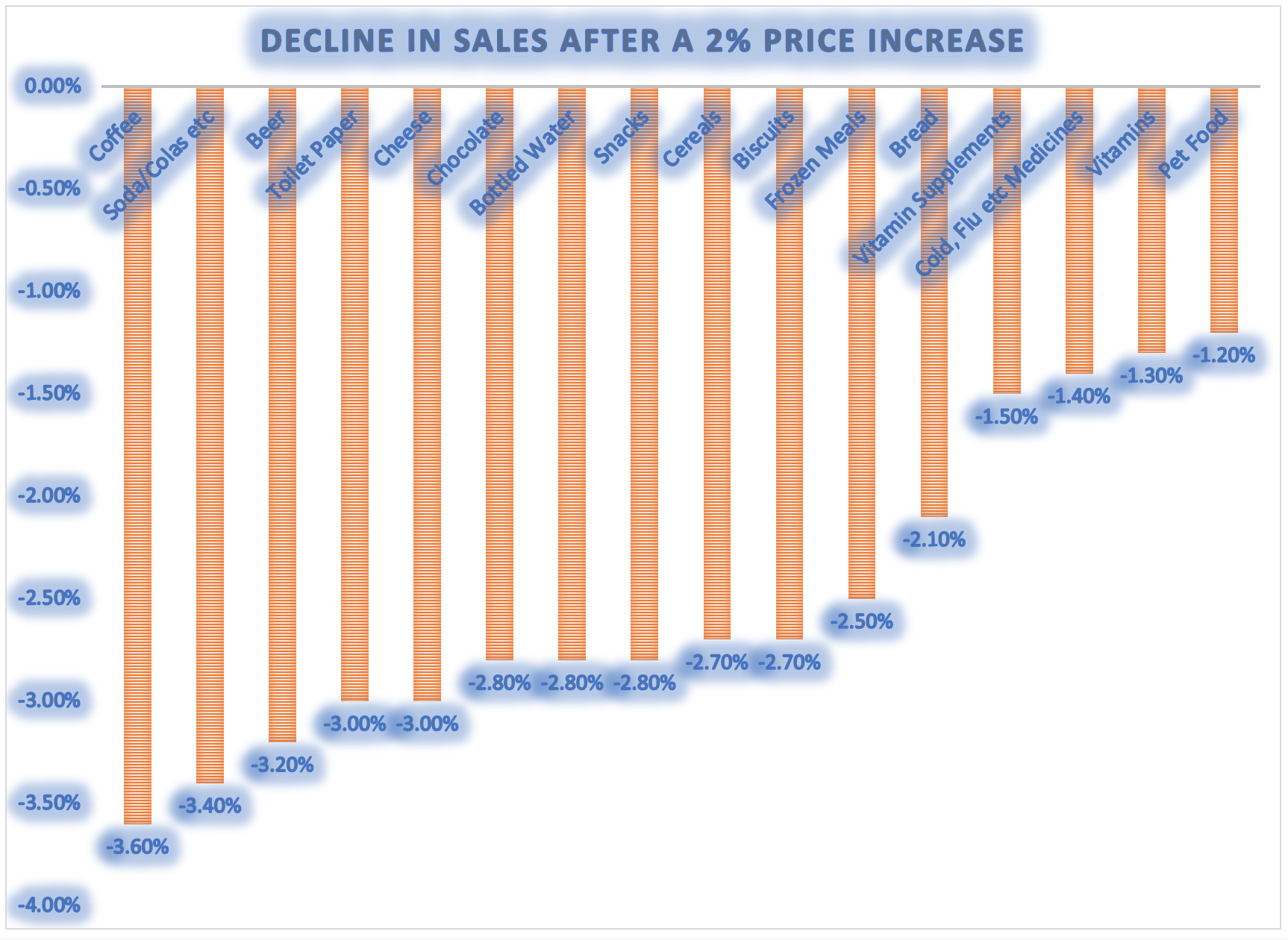
There is a research firm called IRI which analyses scanner data across 125,000 US stores, chemists and other outlets to assess how unit sales change when prices rise (yes, 125,000). The Economist uses this data to assess trends in retail and I have taken some of their findings in the graph attached. This data broadly covers 2019 to 2021 for 15 standard consumer products and is US based, but I don’t see any reason to assume the UK would be different. It shows how unit sales of a particular line item will tend to fall if there is a 2% price increase (falls are generally proportionate to the price rises – 4% price rises will generally double the unit decline on a 2% increase.) Interestingly, data from 2022 seems to show that consumers are less price sensitive – and this may be a factor of inflation. If buyers are expecting 5% or 8% inflationary price rises then they don’t compute what they see in the way they did pre-2021. We can treat this chart as basically “inflation neutral”.
The consumer purchases which were most affected by a 2% price rise are colas, beers, toilet rolls and coffee, individual brands often seeing a 3-4% sales decline. This is not surprising – there are many alternative brands sitting alongside on the shelves and consumers can easily trade down, often to own-brand items. The items at the other end of the chart- Medicines, Vitamins and Pet Foods don’t show much of a decline in unit sales when there is a price increase, perhaps not even 1%. This is also to be expected. If you are taking Paracetamol for migraines, then you don’t switch to Aspirin if the price rises slightly. And Pet Foods are the least affected of all by price increases – and everyone who has a dog or a cat knows why. They have their preferences and offering a cheaper alternative leads to upturned noses. Children can be induced to drink a new cola, dachshunds are far more selective.
And I cannot stress enough that the great majority of our events do not have a cheaper or better alternative sitting next door on the shelf – in terms of time, location and sector exhibitors are not faced with obvious alternatives, even if they wanted to look for one.
How do other sectors deal with pricing questions?
So I asked a few friends in different commercial businesses how they deal with the complex question of pricing. The Marketing Director of a major soft drinks and snacks organization said that they were obsessed with it (their cost base is predictably steady apart from inflation of raw materials). Every week they look at 500 or so different outlets to see how sales move and whether competitive drinks affect the results. Of course, not all outlets are the same – you will pay more for a Coke in a bar than you will in a supermarket. But the overall information on pricing and competition is effectively monitored constantly in real time. And it is easy to test price variations (up and down) in a small number of supermarkets or bars.
A friend in the hotel industry said the same. Nowadays 80% of bookings come through sites such as Booking.com and Hotels.com where clients can compare prices across a range of hotels. As a result, in his particular hotel segment they compare literally hundreds of hotels in real time to assess their pricing strategies. It is very easy to test price increases by doing so in just one or two cities for, say, 4 weeks and seeing how this affects predicted bookings. Like airline seat prices, room prices vary from week to week according to historical demand and local circumstances (in Oxford try to book a hotel in graduation week). My friend added a rider – at the very top of the market pricing is much more flexible. If you want to stay at The Savoy or Claridges you will probably pay what it costs.
Why would sticky toffee pudding be cheaper?
Another friend who runs restaurants gets tired of my questions. Recently he had 7 dessert options – 5 were at 7.95 but two (Sticky Toffee Pudding and Crème Brulee since you asked) were at 7.50. Why I asked? Is he really going to sell more Crème Brulee at 7.50 than 7.95? And diners will only have one dessert and, having gone through the menu to the pudding stage, they were hardly going to up sticks and go to Joe’s next door for their Sticky Toffee Pudding. He flustered that it was something to do with cost added, but the reality was that the question had never been asked and his pricing was plain silly.
And how do our venues deal with this?
And so to our own industry. I spoke with one of our most respected (and smartest) decision makers at one of our larger venues. I know that prices are rising this year in a reaction to inflation and catching up post-Covid – but why do they have a rack rate of X pounds per square metre rather than X+1 or X+2 or any other number? After all, Spring Fair cannot leave the NEC and DSEi cannot leave ExCeL and The Ideal Home Show is unlikely to leave Olympia (there are plenty other examples, but these are obvious ones).
“Well, first of all, don’t imagine we don’t debate it constantly – in the UK the venues are all business propositions, unlike the Messen. We have to consider that our customers are different – trade associations have different customer models and pressures compared with Reed or Informa or Clarion. Add to that the obvious awareness of what our customers are charging their customers – a Furniture Show can be 150 psm because three piece suites and beds need a lot of space, while some Fintech shows can be 800+. Then there is timing – we can offer a customer a better rate the first week in September if they baulk at the rate for the third week of October. And then there are the softer issues – historical expectations, whether we can lead a market but can’t stop our customers kicking and screaming, all with longer term implications. And it is not all about the cost of the space – a very large consumer show can bring massive extra revenues in the restaurants, the bars and the car parks of many venues. We are a slow cycle industry and we generally need a three-year certainty, or near certainty, of what our bookings and revenues are likely to be. If we drive customers away for pricing reasons, then we cannot necessarily be sure we wont just end up with empty halls. We have to take account of all these factors and more. Yes, it’s multi-dimensional and we would never argue we always get it right.”
I yearn to be generous, but…
And so what do I conclude?
As ever, I want to be generous, but I find it hard to be so.
Industries where there are real competitors make pricing an obsession and an art form. They have to. But trade shows do not face those conditions and, partially as a result, trade show margins are typically good. Thus it seems that discussions about pricing and what the market will really bear, and (perhaps more importantly) how to test such propositions, are as rare as an intelligent argument in favour of Brexit.
By and large the evidence suggests that our show teams have relatively little idea why they price their square metres at 375 rather than at 399 or 420 or 440 or any other number you care to name. They do not know how their customers would react, if at all, to a material change in that number. The number is the number. I wonder whether this will always be the case…