

By Phil Soar, Chairman of CloserStill Group and Nineteen Group
If you want to know how we are faring, the EIA (the collective associations of AEV, AEO and ESSA) have just released their 2025 SASIE report. This is now the only comprehensive review of the UK industry which we can turn to. It began in 2015, so although that is 11 years, we can analyse it as a decade of the UK industry.
There are some very positive indicators.
The associated economic impact study suggests that our industry, despite total government indifference, contributes some £11.5bn in economic activity and supports 126,000 jobs. Based in West London, we are one of no more than half a dozen industries in which the UK clearly leads the world.
“SASIE have been able to obtain more and more data from smaller venues”
SASIE recognises 1,154 events which have a gross exhibition space of at least 500 square metres. This compares with around 1,000 events in 2019, the year prior to Covid. This does not necessarily mean that there are now more exhibitions. What it means is that SASIE have been able to obtain more and more data from smaller venues and are now probably able to cover anything which can be called an exhibition. In other words, many of those extra 154 events were probably already there, but just not recognised.
Having said that, SASIE is very careful when making year-on-year comparisons to ensure that they are like-for-like and thus to not count “newly added” events.
Annual visitor numbers are well up
The most encouraging finding is in visitor numbers. Attendees at trade shows were up a stunning 10% compared with 2024 and registered the highest number in total since 2015. Visitors to consumer shows were also up, but only by 1%.
“Attendees were up a stunning 10% compared with 2024 and registered the highest number in total since 2015”
It is worth stressing that total visitor numbers (estimated to be 6.8 million in 2025) are still 24% below where they were at the time of Brexit. This is entirely because of the decline in attendees at consumer events – which have fallen by over a third in the decade. Because there are still far more visitors to consumer events than trade events, the overall result masks the fact that visitors to trade events have grown.
There are, nonetheless, 11% more trade exhibitions than were recognised in 2015 (and 3% more than in 2024) though there are 5% fewer consumer shows. Trade exhibitions probably now represent at least 75%, and quite probably 80%, of all the revenues generated by our industry.
Trade shows have grown; consumer events have declined
In terms of square metres, the average trade show is 1% larger than in 2024 but, unfortunately, consumer events show a continuing decline in square metres, with the average size down 8% year on year. This is despite visitor numbers to consumer shows holding steady.
Overall, our industry has now stabilised and is growing a little. Nonetheless, the decade-long trends cannot be ignored. To quote the report directly:
“Average gross size, duration, visitor numbers and exhibitor numbers remain at approximately 75% to 90% of their pre-Covid levels.”
Putting our industry in context
It is foolish to consider these findings without considering the environment in which our industry has operated in the past decade. Just a few snapshots:
- We have worked through three major crises – Brexit, Covid, Ukraine and perhaps we are now seeing a fourth. Of these, Brexit was by far the most significant.
- The Gross Domestic Product of the UK is now 6-8% lower than it would have been had we voted remain in 2016 (figures from Goldman Sachs and Stanford University comparing with the other G7 countries and the EU). Overall, our trade shows are in many ways a proxy for the whole economy, so we must suffer proportionately as the UK economy fails to grow. In addition, the annual government tax take is some £50bn lower than it would have been had we remained, leading to permanently higher tax rates and lower economic activity.
- Manufactured exports have declined 24% since 2015. I stress this does not include service exports. But it means that UK firms are producing less and exporting less, and thus have less need to attend trade shows.
- The explosion in post-Brexit bureaucracy (one pharma company said that they have had to reclassify 23,000 products as UK standards no longer align with Euro standards) has meant that many European companies no longer bother with the UK market and UK companies stop exporting because of similar bureaucratic hurdles. Changes in tariff rates have had little effect – it is the paperwork that kills.
- The most important of all manufactured goods is motor vehicles – including thousands of sub-contractors. In 2016 the UK produced 1,650,000 motor vehicles. In 2025 it produced 700,000, the lowest number since 1953. Slovakia, a country of 5.4 million people, produced 1,100,000 vehicles in 2025, including all Land Rover Discoveries.
Looking at the last decade of the industry
Below are a small number of charts showing the trends since the first SASIE report of 2015.
The most startling observation of all – exhibitor numbers

For a long time, I was very sceptical about these findings. In a nutshell, our industry now has 21% fewer exhibitors (using the same sample of events) than it did in 2016. But we have now had years of analyses and I am forced to accept their truth.
“Our industry now has 21% fewer exhibitors than it did in 2016”
Looking at the graph, I think we can see what happened. Brexit was in 2016, but because of the slow cycle of our industry (rebooks 12 months ahead, etc) and the uncertainty of what it all meant, we did not see an effect until 2018.
When it hit, it hit hard – resulting in 12% fewer exhibitors at trade shows by 2019. Then we had Covid and, although many of our sectors have recovered very well (IT, medical and health, security, tourism), the exhibitors did not come back. Though there has been some small recovery, trade shows now have 21% fewer exhibitors than they did in the Brexit year of 2016.
One can argue than Covid had an effect, as it must have done, and the flat economy which has seen real (non-inflationary) wages static for 15 years has not encouraged growth. But the truth is that we have lost one fifth of our exhibitors in the past decade. Data is sketchy, but as far as I can tell, there has never been anything like such a decline in the long history of exhibitions in the United Kingdom. Thank you, the 51.8%.
The overall number of exhibitions
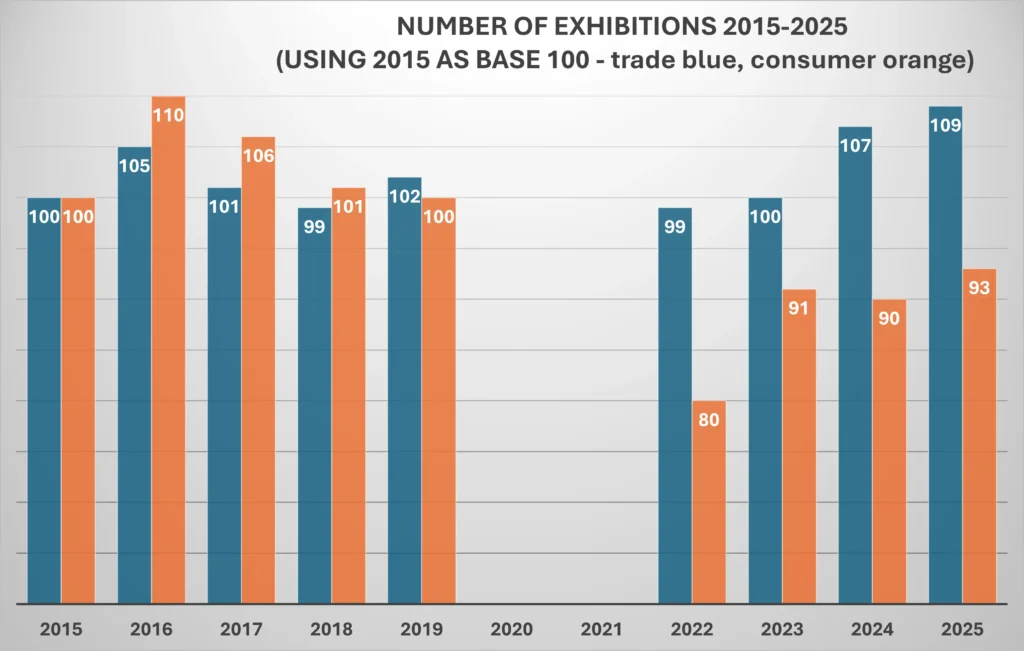
This is more encouraging for trade shows. Essentially the number of trade shows has not declined over the decade and, indeed, there are now 9% more recognised events than there were in 2016 (I stress again that this might, to a small degree, be because of SASIE “finding” more events as it casts its net wider). But while acknowledging this, the average size of trade shows is now somewhat smaller than in 2016.
As ever, this does not mean that your show is smaller – large numbers of shows in areas like IT and medical are a lot bigger. We can only talk in averages as organisers do not let us publish specific figures about specific shows (e.g. Spring Fair was the biggest show in the UK for many years, but we cannot use detailed numbers from that show to illustrate any of our points). Indeed, it is very rare to see exact figures of any kind from individual shows.
“In 2025 there were 16% fewer consumer shows than there were in 2016”
Disconcertingly, the same is not true of consumer shows. Because of their essentially national/provincial nature, consumer shows were not hurt initially by Brexit in the way trade shows were. Indeed, as the chart shows, consumer shows were really quite buoyant until Covid hit. But in 2025 there were 16% fewer consumer shows than there were in 2016. This is not the place for a long analysis of the problems of consumer shows (they now have 35% fewer visitors than they did pre-Covid for instance) but we must conclude that a depressing combination of circumstances has taken its toll.
The decline in consumer shows parallels cinema attendances
The list is long, but for starters: the lack of growth in the economy (personal disposal income has not risen in the decade we are considering), Covid changing people’s habits, online shopping having an effect on visiting transactional “buying” events, high inflation rates in 2022-24 causing budgets to tighten and marginal expenditures being cut, Ukraine’s effect on energy/gas prices, and the “Netflix” effect keeping people at home.
Overall cinema attendances in 2025 were down 31% compared with 2019 – the similarity with consumer shows being down 35% in the same period is surely not a coincidence.
Visitors to UK exhibitions in the past decade
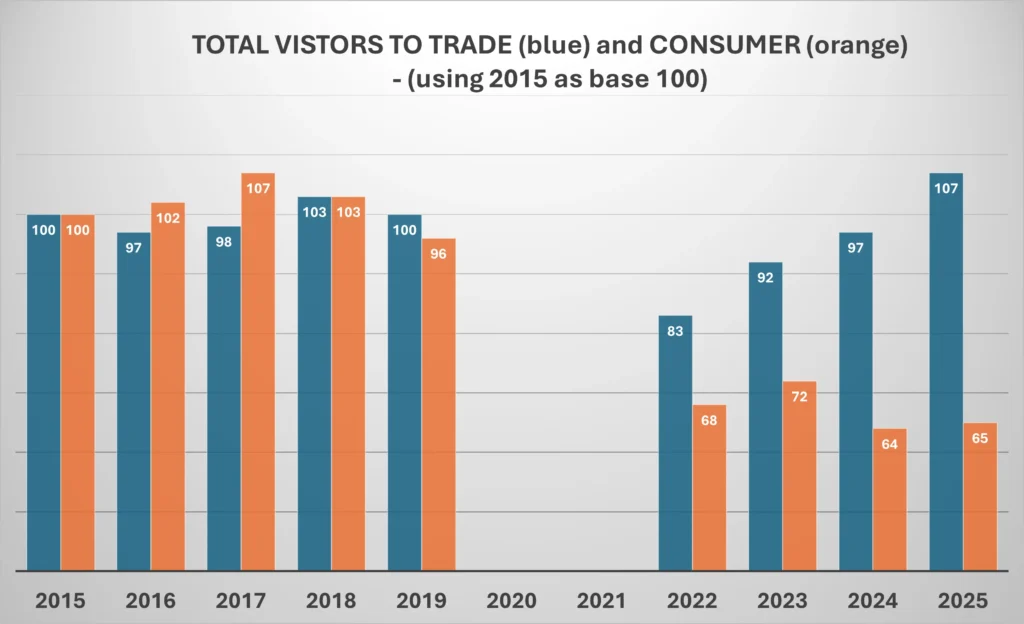
This chart illustrates dramatically the divergence of trade shows from consumer shows since 2015. Visitors to trade shows have shown a reasonably consistent pattern of attendance since Brexit. There was a drop post-Covid in 2022, when many shows did not run, but since then attendance has simply grown and grown. There are 7% more attendees than there were in 2015, and a whopping increase of 16% between 2023 and 2025. This is good news indeed.
“While trade shows are now 75-80% of our industry revenue, they account for less than a third of all attendees”
But on the other side of the tracks, the story for consumer shows continues to depress. It is important to appreciate that, in 2025, some 65% of all visitors to any UK exhibition came to consumer shows. While trade shows are now 75-80% of our industry revenue, they account for less than a third of all attendees.
As the graph shows clearly, attendances at consumer shows are now some 40% below the peak year of 2017 – at which time they appeared to be on a real upward trajectory. To repeat, the decline is paralleled with cinema attendance, and while one should not jump to simplistic conclusions, there does appear to have been a sea change in our habits in the past decade, driven in part by Covid, in part by the lack of growth in personal incomes and, no doubt at all, by social media and the Netflix world.
It is important not to be gloomy, but it is difficult to see what societal trends will turn this graph round in the foreseeable future.
Square metres sold at an “average” event
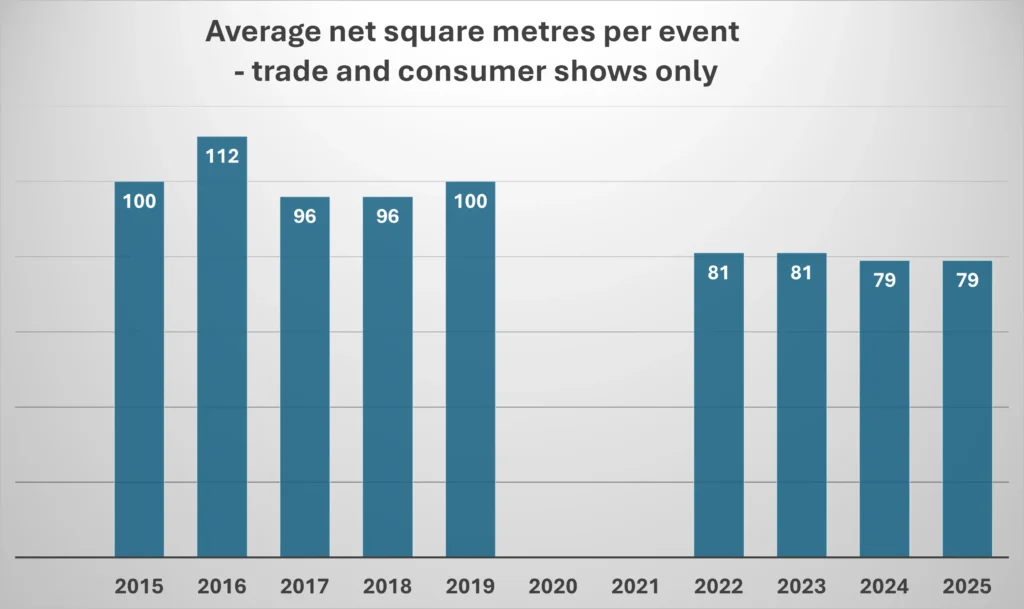
We have to be careful analysing this data as there are always new events each year, and there are now far more “conferences” with 500 sqm gross or above included in the survey. Indeed, “conferences” now account for 27% of all recognised events whereas they were fewer than 10% four years ago. If conferences were included (which SASIE takes care that they are not) they would thus automatically depress the number of “average” square metres.
So, this chart just takes trade and consumer events with a history in the survey, only at the larger venues, and on a like for like basis. In other words, it tracks the same events over a number of years so as to isolate accurate trend lines.
The pattern is surprisingly clear. Between 2015 and the covid years (2020-21), the average event was broadly the same size. But immediately post-Covid there was a drop of some 20%, and this has remained essentially constant since.
A 20% decline in exhibitors – a 20% decline in net square metres
This is not easy to fully explain. Smaller shows in 2022 is simple – recovery from the pandemic. We might have expected the average size to then grow. But this didn’t happen.
A statistical explanation could be to compare the graph of exhibitor numbers with the graph of average square metres. If we compare the number of exhibitors at trade shows with the overall average square metre size, then we have a reasonably close match. They are both down almost exactly 20% from 2017, the year before the Brexit effect really kicked in.
Trade shows are 60% of the trade/consumer mix and therefore far more relevant to this particular statistic.
It seems reasonable to posit that if we have 20% fewer exhibitors at our shows then, by and large, those shows are likely to be 20% smaller. This isn’t provable, but it isn’t obvious what an alternative explanation might be.
Conclusions
There is much that is positive here. The body blow we took from Brexit and the pandemic has passed and UK businesses are stable again. The increase in the number of trade shows and visitors to them (up 10% in 2025) is really encouraging.
And, though I have not covered it here, our major companies are all reporting increasing revenues and are running at meaningfully higher headline profits than before the pandemic.
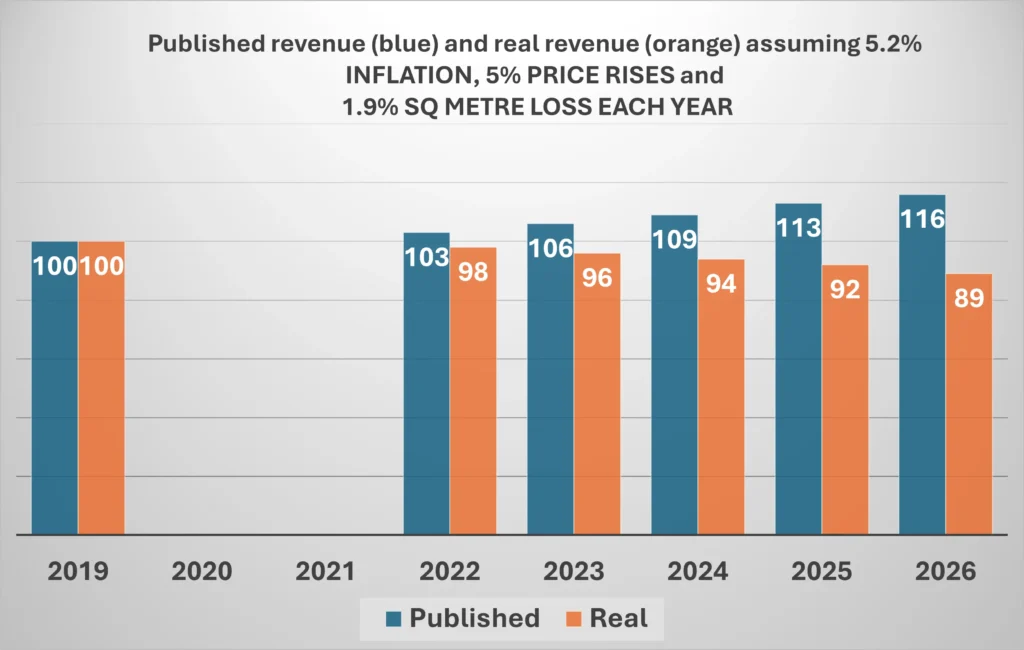
Of course, we must be aware that this compares apples with pears as inflation means that a 2026 pound is now worth only 71 pence of a 2021 pound, but there are very few who pay attention to such subtleties. The way that company reports usually avoid the effects of inflation and are silent on exhibitor numbers are important subjects which I will return to.