
Private equity has been buying and selling event businesses for more than 20 years. But the past few weeks felt different.
Across three major transactions, more than £4bn of reported or estimated deal value has been attached to B2B event assets. CloserStill went for a reported £1.35bn. Apollo is combining Emerald and Questex into a North American B2B events and media powerhouse valued at an estimated $2bn. Hyve is moving to Hellman & Friedman in a deal worth around $1.8bn. That is the strongest year for B2B events investment on record, and we’re only at the end of H1.
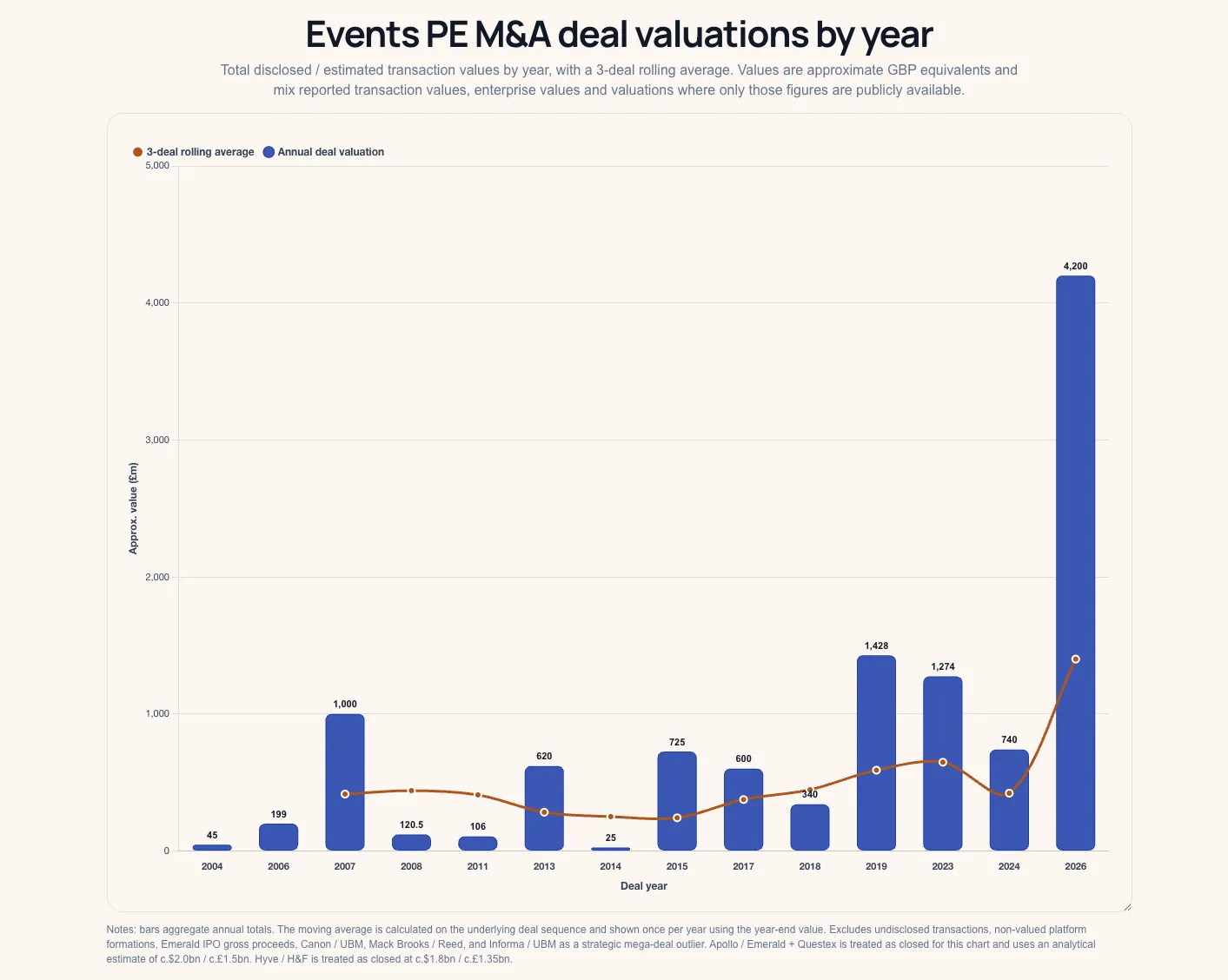
The numbers are impressive, but the more important signal is structural.
In the CloserStill deal, Providence did not simply sell and leave. It stayed in and brought Searchlight alongside; a recapitalisation, not an exit. They chose to stay exposed to the next phase of growth.
That signals where the industry is heading. The best events businesses are no longer assets to buy, improve and flip; increasingly, they are long-term platforms investors want to keep compounding.
In the early 2000s, the playbook was simple
How did we get here? In the early 2000s, the playbook was simple: buy a good asset, back a strong team, professionalise it, bolt on acquisitions, grow it, and sell it on. Flip.
Until about 2013, events were carve-out opportunities for professionalisation and tidying up. Then, Onex paid $950m for Nielsen Expositions, and suddenly, events weren’t mid-market buyouts; they were platforms. The sector re-rated.
Covid was the ultimate stress test, freezing cash-generative businesses overnight, but it didn’t break the investment thesis, because the underlying need to meet in person didn’t go away. Buyers and sellers still needed markets, trust and discovery, and events refused to die.
The cautionary tale sat on the other side of that bet. Hopin, founded in London in 2019, rode the lockdown surge to a $7.75bn valuation by 2021, briefly worth more than Cvent. By 2023, it had sold its core products to RingCentral for $15m.
The flip has quietly become the hold
And since then, the flip has quietly become the hold.
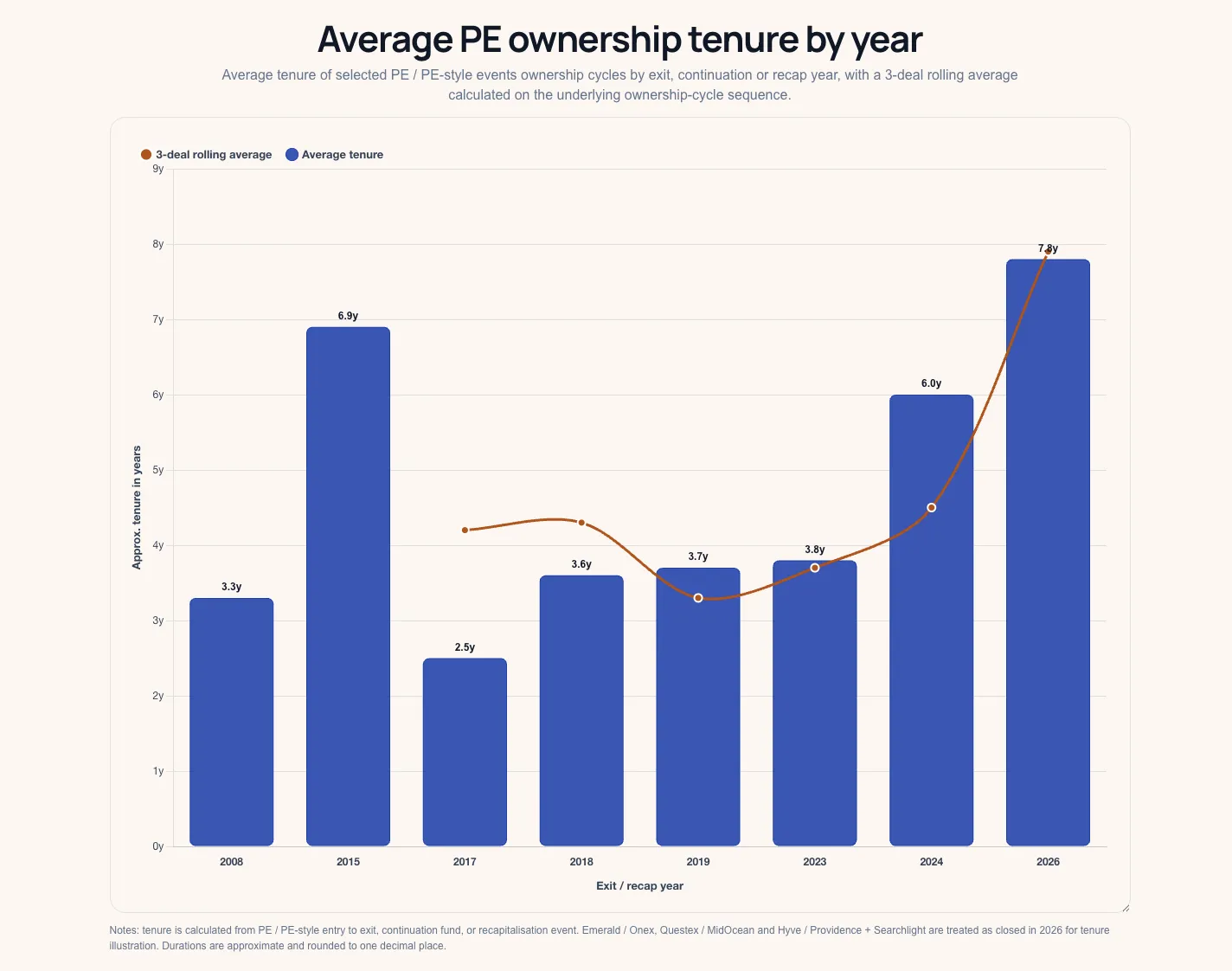
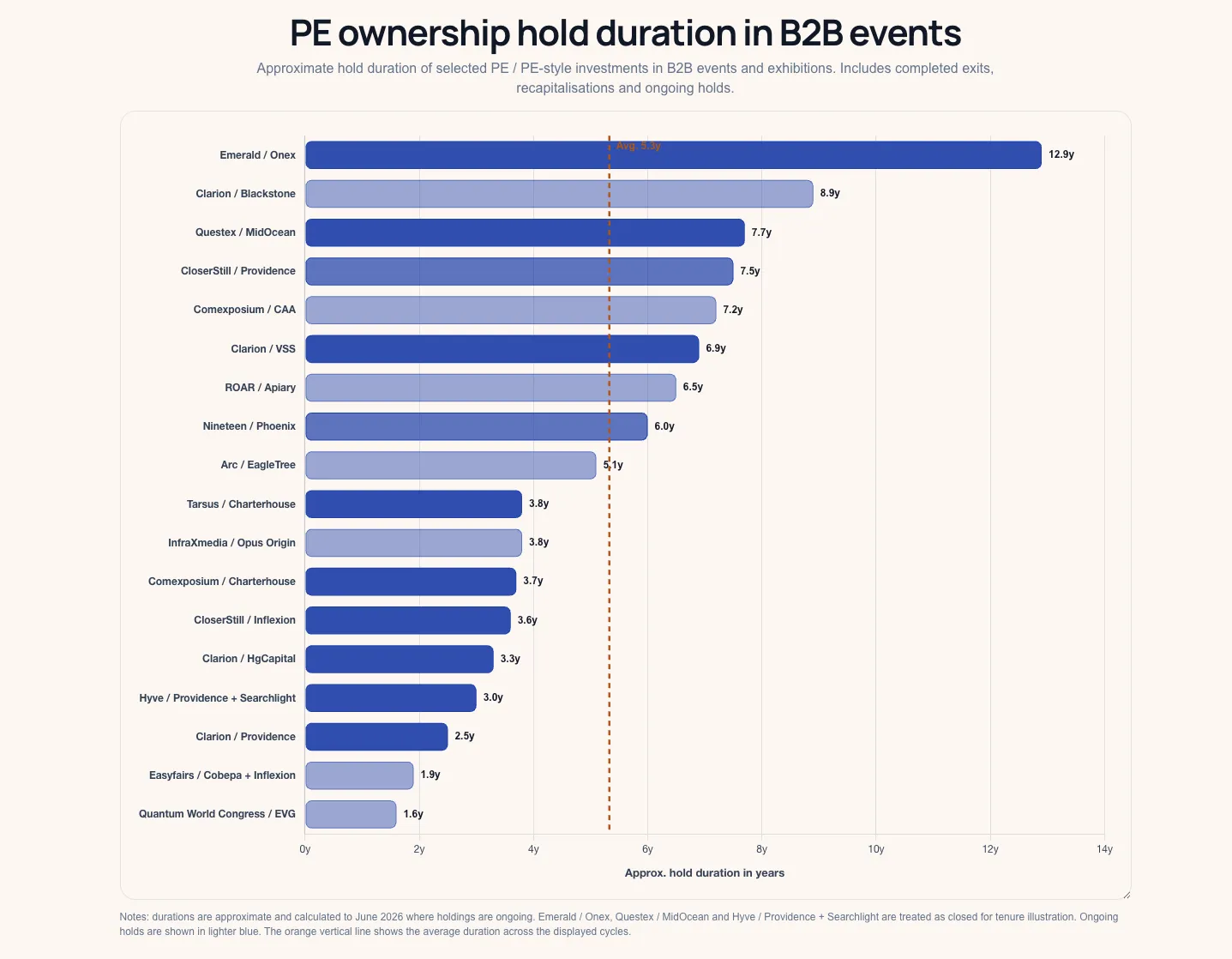
The data backs this up. Average PE ownership tenure has roughly doubled, from about three and a half years in the mid-2010s to closer to eight years since 2023 through three routes that all point the same way: continuation funds (Phoenix moved Nineteen into one rather than selling), insurance capital (Charterhouse sold Comexposium to Crédit Agricole Assurances, a natural long-term holder), and evergreen holding companies (Cobepa backing Easyfairs alongside founder Eric Everard). Blackstone, meanwhile, has owned Clarion since 2017, now into a ninth year.
Hyve looks like the counter-example: a three-year hold, sold on, classic flip. But notice who’s doing what. Providence and Searchlight, the sellers of Hyve, are the same investors staying in at CloserStill. They aren’t choosing between flip and hold across the portfolio; they’re rotating capital out of one platform to back their conviction in another. And H&F is buying Hyve precisely because it believes in a long-duration thesis. So even the flip is, in effect, selling into a hold.
At the strategic end, Informa has been almost the only buyer large enough to absorb premium assets (UBM at £3.8bn, Tarsus at $940m), and RX has been quiet since Mack Brooks. With the strategic bid so thin, co-control deals and continuation funds were partly a response to the lack of an obvious place to sell. But Apollo and H&F clearing around $3.8bn in a single month shows that large alternative managers are now a credible third exit route.
Who has the structure and conviction to keep compounding?
Events are, at heart, handshakes businesses, and Face-to-face still beats every other mode of B2B interaction on three things: building trust, solving complex problems, and speed. Today, as synthetic AI content floods every other channel, the room where real people shake each other’s hands is the hottest asset class.
This changes the question for event owners. It’s no longer simply: who buys next?
It is: who has the structure and conviction to keep compounding?
For a more detailed analysis and the underlying dataset, visit here