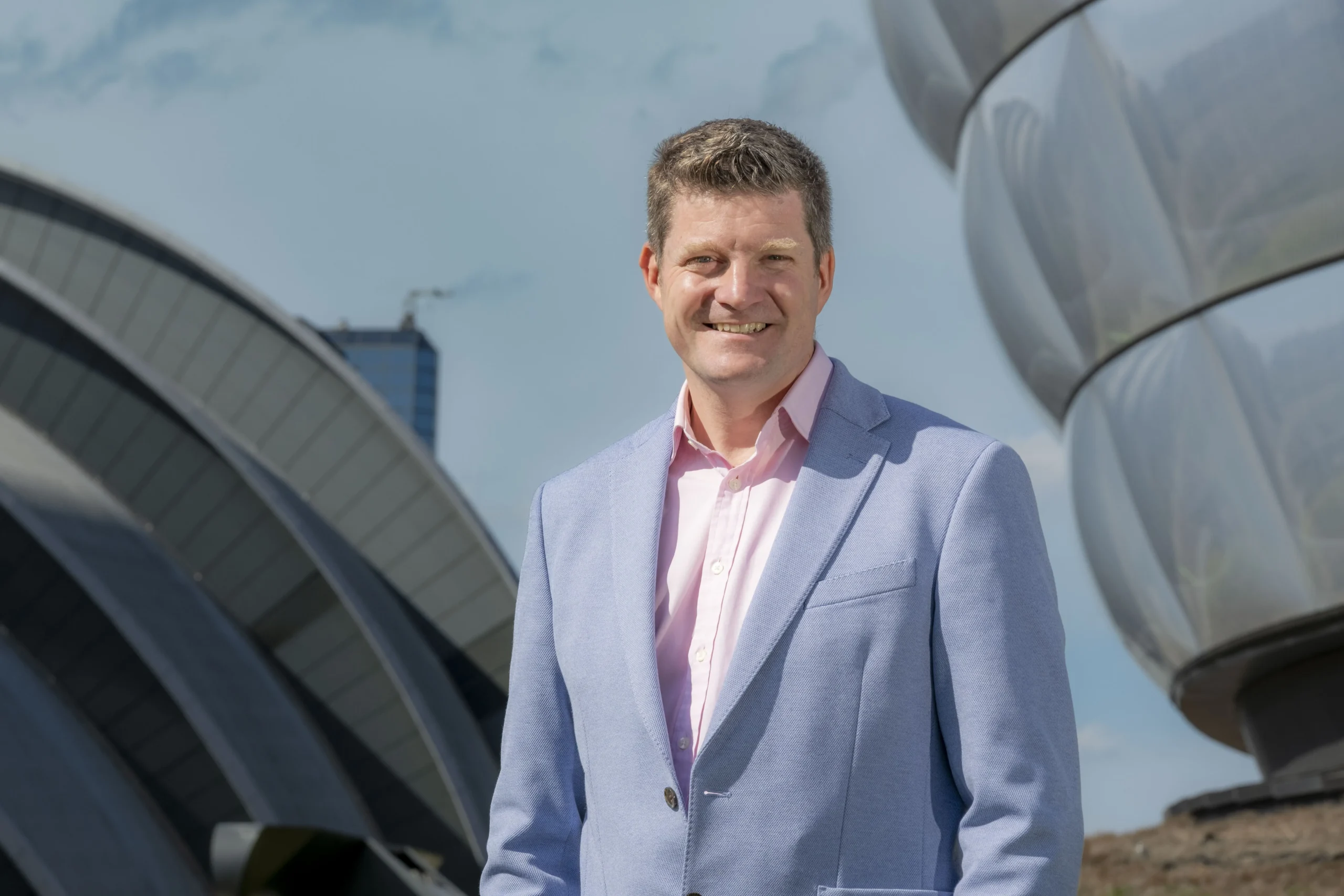
Dominic McKay, chief executive of the Scottish Event Campus (SEC) reflects on the venue’s 40-year journey, its global influence, and what lies ahead.
When the Scottish Exhibition Centre opened on the banks of the Clyde in 1985, it marked the beginning of a new chapter for a city whose influence had already shaped the world. Glasgow’s heritage as the second city of the Empire was built on industry, innovation and ambition. Four decades on, that same ambition is channelled into a different kind of engine.
The city that once powered global trade now powers global conversation. The Scottish Event Campus (SEC) stands at the centre of this transformation, evolving from a single exhibition hall into one of Europe’s most dynamic and integrated events destinations. Celebrating forty years gives us a chance to reflect on just how far the campus and the city have travelled.
The SEC welcomes millions of visitors each year while enabling conferences, exhibitions and live events whose impact is felt far beyond the banks of the Clyde. Over the last three years alone, the campus has generated around £1.45 billion of net additional economic impact for Glasgow, £950 million for Scotland and £740 million across the UK. These financial results reflect more than visitor spend or venue capacity. They show the scale of collaboration, idea-sharing and innovation taking place here, with outcomes that resonate across industries and continents.
Some of the most significant global health discussions of the past decades have taken place in our venues. HIV Glasgow has returned to the SEC since the 1990s and continues to shape international understanding of treatment, prevention, community engagement and long-term patient outcomes. It is not an exaggeration to say that conversations held in Glasgow have helped influence shifts in global guidelines toward the modern reality of HIV as a chronic, manageable condition.
Likewise, the European Academy of Allergy and Clinical Immunology (EAACI) Congress, held at the SEC in 2025, brought more than 7,500 specialists from over 100 countries to Glasgow. Their discussions ranged from asthma and anaphylaxis to the effects of climate change on immune health. At a time when environmental, medical and social challenges overlap more starkly than ever, Glasgow hosted one of the most important cross-disciplinary medical conversations in Europe.
The impact is just as clear in the world of climate and energy. In 2021, COP26 turned Glasgow into the centre of global diplomacy. For nearly two weeks, the SEC housed both the UN’s Blue Zone and the UK Government’s Green Zone, enabling thousands of negotiations, side events, civil society meetings and policy debates. The result was the Glasgow Climate Pact, a landmark agreement that advanced commitments on coal phase-down, methane reduction, climate transparency and adaptation finance that will be referenced for decades to come.
That spirit of climate leadership continues each year with All-Energy, the UK’s largest renewable and low-carbon conference and exhibition. Under a renewed multi-year agreement, it brings together offshore wind developers, hydrogen innovators, grid operators, investors and government leaders, with Glasgow serving as a hub for the next wave of the energy transition.
Such multi-year renewals highlight confidence in the venue and the city, while new arrivals such as Space-Comm demonstrate how Glasgow continues to push into emerging sectors. Space-Comm Scotland, which brought more than 2,300 delegates in its first year, landed at a moment when the UK Space Agency committed £4.6 million to Scottish innovation. The symbolism was clear. The city that once built ocean-going vessels is now contributing to the next era of exploration.
Looking ahead, the Ocean Sciences Meeting in 2026 will take the campus into another historic moment. It will be the first time the biennial meeting has been held outside the United States in its 40-year history. Thousands of climate and ocean experts will gather in Glasgow to discuss marine heatwaves, coastal vulnerability, fisheries resilience and the ocean’s role in the global climate system. For one week, the Clyde will host the world’s leading ocean thinkers, reinforcing Glasgow’s role as a stage for decisions that extend far beyond Scotland.
And of course, exhibitions and cultural experiences remain central to the SEC’s identity. This past summer Tutankhamun: The Immersive Exhibition became the longest tenancy in the campus’s history, welcoming more than 130,000 visitors and demonstrating Glasgow’s appetite for large-scale immersive content. Perennial favourites such as Comic Con, Hyrox and Horror Con, alongside emerging science, industry and lifestyle exhibitions, show the breadth of what the SEC delivers every year.
Forty years after the doors first opened, the SEC embodies Glasgow’s evolution from industrial powerhouse to modern global events capital. The ambition that once built the ships of the Empire now builds partnerships, discoveries and decisions that shape the future. As we look to the next forty years, the SEC will continue to reflect the spirit of the city itself: outward-looking, innovative and ready to welcome the world.