

The exhibition industry has entered a new phase following several years of pandemic-induced volatility. The upcoming Global Industry Performance Review 2025 (GIPR) – published by jwc and set for release in January 2026 – takes an in-depth look at the current state of the industry and its key markets.
Ahead of the report’s release, Exhibition World spoke with Lorenzo Garbujo, jwc’s director and lead editor of the GIPR, and Timo Wanninger, consultant and co-author, who shared insights from the forthcoming edition and explained what readers can expect.
EW: What’s new in this year’s edition of the Global Industry Performance Review?
Lorenzo Garbujo: We’re pleased to present this year’s edition of the GIPR, which reflects the continued growth and refinement of the report. The 2025 edition expands significantly in both scope and analytical depth, now featuring standardised market profiles for more than 30 key countries across all world regions – including selected African markets alongside those in Europe, North America, South America, Asia, and the Middle East.
Unlike past editions, GIPR 2025 does not focus on a few selected individual markets. The new format provides comparable country coverage, offering a more comprehensive view of global macroeconomic trends and the dynamics of the business events industry worldwide. In addition, we have significantly expanded our event database, with broader coverage of event-level KPIs. These data points form the foundation of our market profiling approach, as the insights across all markets are derived from aggregated event-level analysis.
EW: How would you describe the current state of the global exhibition industry?
LG: The industry has partially stabilised following the post-pandemic rebound, but momentum is shifting towards structural transformation, with evolving event formats and portfolio consolidation in mature markets. Growth has returned, but it is increasingly characterised by shifting business models, innovation, and efficiency rather than pure volume. I think the industry is experiencing change, driven by shifting demographics and AI, but I also believe it can adapt successfully in a world increasingly hungry for genuine human connection.
EW: How are different markets responding to these shifts – and which ones are proving more resilient or better positioned than others?
LG: We continue to see sluggish demand in mature markets, particularly for consumer shows. A number of these events are under pressure, leading to bold strategic moves – including the relocation of major shows, consolidation under unified brands, and even discontinuation in some cases. German Messen are streamlining their portfolios and continue to explore opportunities to export their top brands to high-growth markets in Asia and the Middle East. Overall, Europe remains relatively stable, with international participation rebounding in 2024. Interestingly, more players are now exploring internationalisation within Europe itself, signalling a new trend.
2024 was a moderately positive year for North America, with the US navigating a complex business environment and showing limited growth compared to 2023. The market remains below pre-pandemic levels, and full recovery is not anticipated before 2026.
Latin America stood out for its growth in 2024. Driven by strong performance in its three largest markets – Brazil, Mexico, and Colombia – the region has essentially returned to 2019 net rented space levels in 2024. Alongside the Middle East, it was one of only two regions to achieve this milestone.
EW: With traditional business models and mature markets under pressure, how are organisers redefining their strategies?
LG: Organisers have been expanding their value propositions – no longer merely providing space and infrastructure for events, but evolving from event operators into ecosystem builders, creating business platforms that extend beyond the show floor. This shift is reflected in the changing revenue structures of leading companies, with service-related income streams rising in recent years whilst space rental revenues have declined. Still, floor space sales continue to represent the core driver of event turnover.
Moving forward, it will be interesting to see how event formats adapt to evolving demographics and shifting customer expectations – and how these changes will impact event size and participation. Our report addresses these trends, drawing on a significantly expanded repository of events to track event and company KPI developments across regions.
EW: How was the performance of the top exhibition companies in 2024?
Timo Wanninger: In our Top 40 chapter, we analyse the leading exhibition companies, examining both financial and operational KPIs to understand the industry’s overall performance. This group was expanded this year to include new global entrants, reflecting the evolution within the sector. The results show solid momentum. In 2024, the leading companies recorded an average year-on-year revenue growth of around 14%, with total revenues now standing roughly 20% above 2019 levels. After a strong recovery from the pandemic downturn, these companies achieved a CAGR of about 4% between 2019 and 2024 – clearly outpacing global GDP growth of around 2–3%.
EW: Are there notable differences within the group of leading companies?
TW: We observe significant performance differences depending on ownership structure and operating model. Privately held and listed companies have been the main growth drivers in recent years, achieving an average CAGR of around 4.9% between 2019 and 2024 – more than double the rate of government-owned organisations, which grew by about 2.3%. Performance also varies across business models. Pure organisers have led the way, recording average annual growth of around 4.6%, whilst venue operators and mixed-model groups have developed more slowly at roughly 3.4%.
EW: How do you account for these structural differences in your analysis?
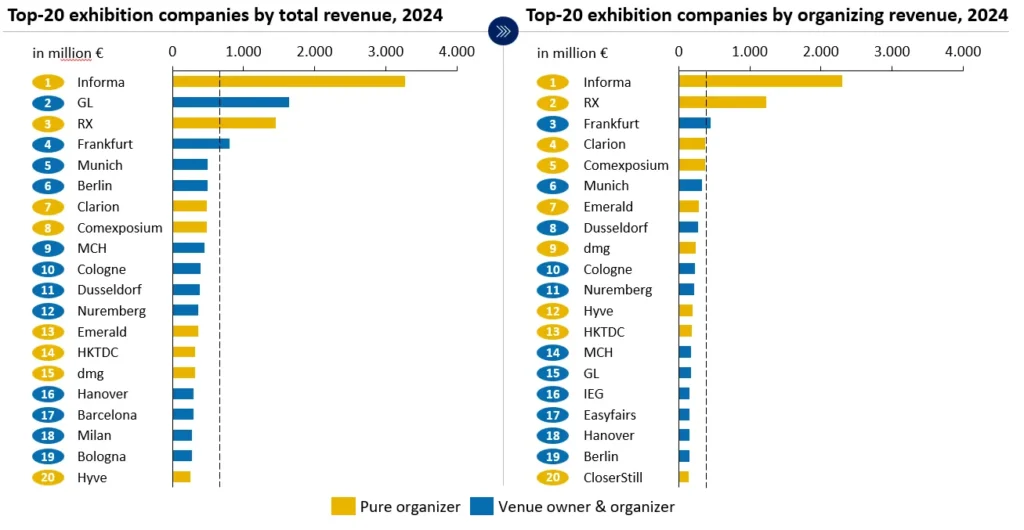
TW: Building on these observations, we consider the profiles of each company when interpreting the results. In our revenue rankings, for example, we distinguish between business models by analysing both total company revenue and event organising revenue. We apply a threshold that includes only companies where at least 10% of total revenue is derived from organising activities.
The ranking on the left includes all revenue streams, whilst the one on the right focuses specifically on event organising activities. In the organising revenue ranking, guest events, sponsorships, digital revenues, as well as direct and indirect service income – for example, commissions or kickbacks from service providers – are excluded to reflect genuine organising performance. Also, we do not adjust sales for the revenue-smoothing practices often used by organisers to offset portfolio cyclicality.
This approach ensures that results are consistent and limited to companies’ own events. Only organisations with publicly available and independently verified data are included. Consequently, some major players are not represented in the Top 20 due to insufficient publicly available data. Companies such as DWTC, ADNEC Group, CFTC, and CCPIT, among others, would likely rank within the Top 20 – with DWTC potentially competing for a Top 5 position – but data limitations prevented verification of their figures.
Our benchmarking analysis strives for transparency and comparability in a complex global market. It is particularly important for us not to base our approach on interviews or surveys but rather on publicly available and verified sources to ensure that organisers, venue operators, investors, and associations can rely on a consistent dataset to benchmark performance and support strategic planning.