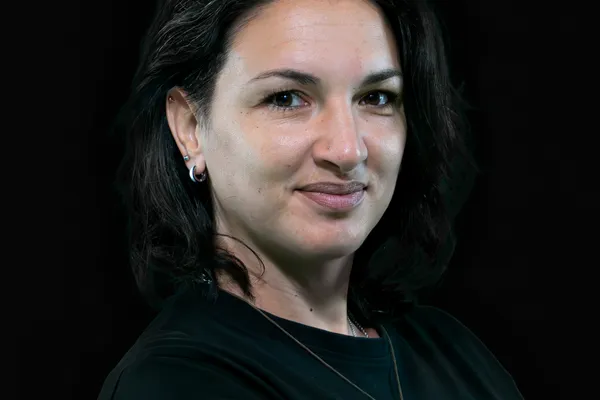

On Friday night (28 March 2025), RX’s CEO Hugh Jones won the EN Pioneer Award for his significant impact on the exhibitions industry over the past five years. To commemorate half a decade at the helm of the world’s second-largest exhibition organiser, Mike Fletcher sits down with the man on a mission to restructure both his company and the way trade shows do business.
When I meet RX’s CEO Hugh Jones, we both carry secrets we don’t want each other to discover. I know he will be honoured with EN’s prestigious Pioneer Award at our industry awards ceremony at the end of March. He knows RX’s full-year financial results, which won’t be common knowledge until Valentine’s Day, a few weeks after our interview.
Soon, both secrets will be out in the open. For now, though, we need to begin our interview on safer ground so the conversation starts with golf.
Jones has just returned from RX’s 72nd PGA Show in Orlando, Florida. It is considered to be golf’s longest-running and largest global business gathering, featuring more than 33,000 golf industry professionals from 94 countries and all 50 U.S. states who come together to meet with over 1,100 participating brands.
“We’ve introduced a ‘demo day’ the day before the PGA Show opens,” Jones says proudly. “Orange County National Golf Center has an expansive circular driving range, so 70 exhibitors take space around its circumference. The golfers can drive carts around the perimeter, stopping to test the latest equipment and hitting balls into the centre. Together with the warm climate, it’s why we still stage it in Orlando.”
I ask if he plays. He replies: “I do play. I’m not particularly good, but I don’t slow anybody down. I enjoy the game, though. There’s a golf course in the US that I loved growing up, which was designed by the legendary Robert Trent Jones. I named my son Trent Jones after him, but sadly, it hasn’t improved my game much.”
Jones grew up in the ‘rust belt’ city of Buffalo, New York, which he says is only famous for three things—its proximity to Niagara Falls, the Buffalo Bills’ American football team (his favourite sports team), and Buffalo chicken wings.
He became the CEO of RX in February 2020, having managed other companies within the RELX portfolio, including the Risk and Business Analytics division, where he served as global managing director before joining RX.
One month after his appointment, the world shut down due to the Covid-19 pandemic. Jones has talked before about what a baptism of fire it was, but five years on, he now looks back and believes that the accelerated transformation of RX would have had to have happened anyhow.
He explains: “In late 2011, the market capital of RELX was around $15bn. Today, it’s closer to $90bn and one of the top-performing stocks on the FTSE 100. It evolved from selling print advertising to selling data-led insights and AI-powered actionable support. I knew a similar transformation was needed for RX. With or without Covid, we had a company structure with too many silos and more than 100 shows that weren’t making any actual profit but had remained part of our tail for too long.
“By closing the tail and getting rid of the non-profitable shows, we could reduce staff and strip out silos. Covid was the excuse we didn’t know we needed to start again with a blank sheet of paper and ask, ‘How should we build back this company better?’.”
RX’s subsequent restructuring saw over 130 exhibitions closed or sold across 42 countries, with thousands of employees leaving the organisation.
Jones states that, despite the disruption, employee satisfaction scores have risen since 2019. He puts it down to the greater accountability and increased responsibility given to those remaining staff members.
“It created a sense of pride in what we were trying to achieve,” he says. “Staff knew that they had to perform every day and what they did mattered. This renewed sense of purpose resulted in a more satisfied workforce.”
Jones has been rebuilding RX over the past five years as a matrix, meaning that salespeople, marketers or even show directors can move from one sector to another – from one event to another, and still be successful.
“Five years ago, RX employees only had their show logos on their business cards. At the time, they believed the value was in the show brand rather than the parent company. It’s not true. I want people to know that when they visit or buy stand space at an RX show anywhere in the world, they’re buying into an exhibition that’s professionally run, highly curated, safe, and right for their business,” he explains. “If we’re negotiating with a venue, I don’t want them to think they are negotiating with a single show. They need to consider the impact of RX having seven or eight shows in their venue before they tell us we can’t have a certain date or extend by a day.”
Jones admits that his leadership style is one of risk-taking, accountability and courage. He believes that to succeed at RX, you need all three traits in abundance.
“When you only have 80% of the data, but you don’t have time to wait for the other 20%, you need the courage to make strong calls. Some of your decisions will be wrong, but having the courage to make them makes you a better executive than you were the day before,” he says. “I don’t believe you should ever run the same show from one year to the next. You should always place three or four big bets that may not work. And if they don’t work? Own it and learn from your failures.”
Jones warns that without risk – without big bets – exhibitions can lose relevancy quickly. He believes that every RX show should continue to evolve and embrace change as part of its journey.
“If that’s what you’re comfortable doing – taking the ring-binder down from the shelf year after year and putting on the same show, my advice would be to go produce West End musicals. Nobody wants to hear Phantom of the Opera sung differently,” he says with a laugh.
However, workplace culture is a difficult tanker to turn, so I ask Jones how much impact he thinks he’s had and what still needs to happen.
“We are known for our incrementalism,” he replies. “Every day, we try to do one thing better than we did the day before. When I look back three, two or even a year ago, I can see the incremental progress we’ve made.
“There is, of course, so much more we can do, but it’s just getting interesting. We now have much more resilient people running our shows who are no longer afraid to fail. If you have two failures but three successes, it means you’ve gained experience and something to talk about – that’s a completely different culture from where we were five years ago.”
A month after we spoke, RX reported that its trade show revenues had grown 11% in 2024 to reach £1.23bn, with an adjusted profit that was up 31%. Although an impressive double-digit growth, it was notable that it had slowed from 54% in 2022 and 30% in 2023.
With an incremental slowdown in the global exhibitions market, Jones’ continued philosophy of being courageous and taking risks will be a seminal strategy to stay out in front.
When RXl’s results were revealed, something Jones said about his organisational restructure came to mind: “The best time to plant a tree was 20 years ago. But the next best time to plant a tree is today.”
Jones’ pioneering vision saw his trees planted in 2020. Five years on, the results are beginning to show.
RX CEO Hugh Jones on….
Developing a data-led company
“The siloed nature of RX meant that we never had a single data lake. We do now. If I buy a show tomorrow, its data is scrubbed, cleaned, made compliant and added to that data lake. The data from one show is nowhere near as important as the collective data from all our shows. We’ve built a foundation that will inform all future decisions and tell us what is coming next across multiple sectors.”
Helping exhibitors measure ROI
“Through our dashboard technology, exhibitors can see who came to their booth, how long they stayed, what products they were interested in, and what follow-up is required. It has helped our exhibitors to return to their organisations and prove that trade shows matter.”
Sustainability
“Business travellers emit far less carbon visiting a trade show than they would having 10 meetings with 10 different suppliers. It remains a fact, though, that trade shows are still too wasteful. As an industry, we need to move away from the model of how it has always been and embrace the circular economy.”
Charging vistors to attend
“If you don’t feel you can charge visitors to attend your trade show, what exactly is the value of the exhibition you’re staging? We need to start charging collectively as an industry, which would allow us to better track, audit and offset carbon emissions. In the next three years, most of our trade shows will charge vistors to attend. I imagine it will become the standard.”
The future of trade show pricing
“We need to become more creative about how we sell. Selling based on square metres and publishing our pricing means we’re stuck in the 1980s. We create far more value than just the size of a stand. We should charge for our technology innovation and show floor location – setting higher prices for the last two remaining stands in the hottest zone of the floor plan for example. Airlines and hotels do it, so why don’t we?”
Being president of UFI
“I’m really enjoying it. Colleagues such as past president Geoff Dickinson (dmg events CEO) and Michael Duck (Informa EVP) have become friends. They’ve worked in exhibitions far longer than I so, although we compete over elements such as venue slots, talent and acquisitions, they’ve also taught me a lot and shown me areas where we should collaborate as an industry on areas such as improved sustainability, accessibility and advocacy.”
Check out all the winners from the EN Awards 2025 here.